
How to Tell Apart Plants That Look Like Marijuana
Many types of plants can look like marijuana at different stages of growth. It is very easy to become confused when distinguishing Cannabis sativa from ordinary flowering shrubs, trees, or even crops such as cassava. However, once you know how marijuana differs from similar-looking specimens, identification becomes much easier.
What does marijuana look like? Cannabis sativa has long, slender stems, with large palmate leaves attached to the stem at the nodes. These fan-like leaves have serrated edges that often resemble maple leaves.
A cannabis leaf is actually a compound leaf made up of several smaller leaflets. These leaflets meet at the leaf stalk, or petiole. The leaves are dark green on the upper surface and lighter underneath. Both sides are also covered with soft, fine hairs.
Apart from its leaves, cannabis can also be identified by the flower structure of the female plant. Cannabis sativa produces thick flowers protected by small leaves known as sugar leaves. As the flowers mature, the long, hair-like female pistils in the centre begin to turn a deep burnt orange. This usually happens during the seventh and eighth weeks of flowering.
Mature flowers look as though they are coated with clear crystals because of the sticky glandular trichomes on their surface. Cannabis flower clusters usually grow tightly together in formations known as colas.
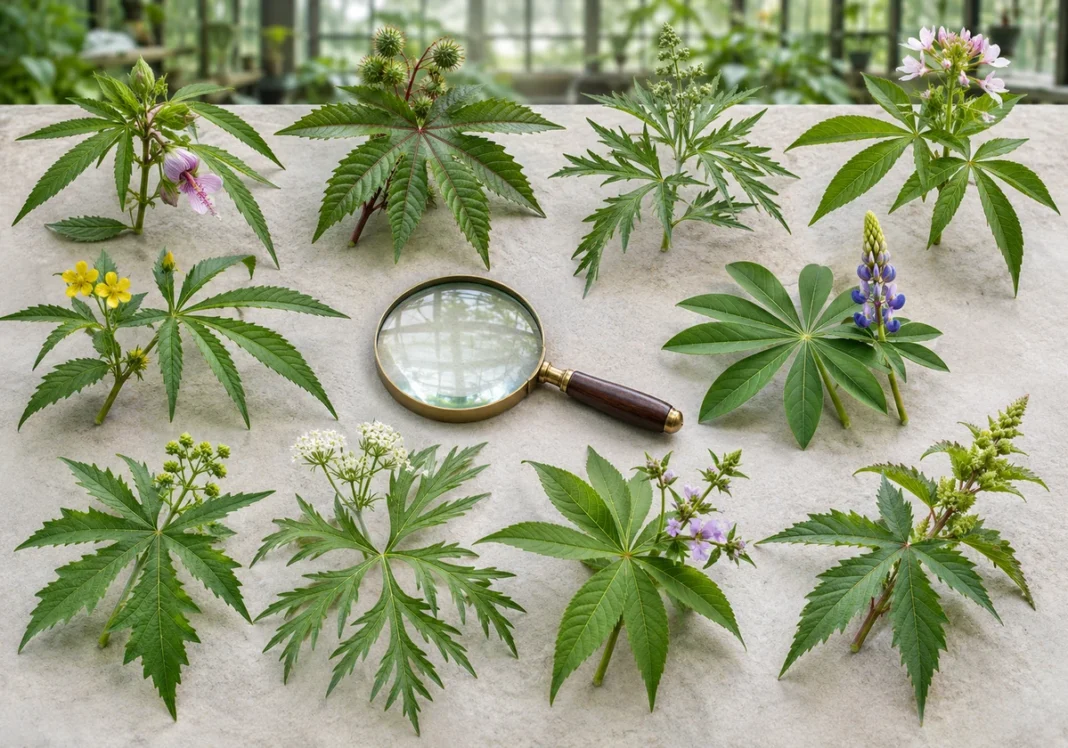
10 Plants That Look Like Marijuana
Many plant species can be mistaken for cannabis. Sometimes only their leaves look similar, while in other cases the plants belong to the Cannabaceae family, which also includes hops, hackberry, and trema. Knowing the plants most often confused with marijuana can be very useful, especially if you plan to grow any of these species.
Likewise, being able to identify marijuana seedlings can help ensure you are not misled when buying cannabis plants.
Here are ten main plants that look like marijuana.
Japanese Maple (Acer palmatum)
The Japanese maple is a famous ornamental tree from Asia. It is often mistaken for marijuana, especially when it is a very young sapling. At this early stage, its stem is still slender and flexible, with bright green leaves resembling the compound palmate shape of Cannabis sativa. Like cannabis leaves, Japanese maple leaves also have serrated or jagged edges.
However, the similarities end there. In late spring and summer, Acer palmatum leaves usually turn striking shades of red, pink, and purple. After the first growing season, its stem becomes woody and thickens into a sturdy trunk. Japanese maple leaves are also hairless, unlike cannabis leaves, which are covered with fine hairs.
Southern Marigold (Tagetes minuta)
Southern marigold, also known as Muster-John-Henry, comes from Central America and is often used for cooking and medicinal purposes. Even so, this shrub spreads easily and is often considered a weed because it grows rapidly in cultivated or disturbed soil. It can grow near crops, vegetables, grasslands, orchards, and wasteland.
As a seedling, marigold looks very similar to marijuana. Tagetes minuta has long, elongated leaves with finely serrated edges. Both plants can also grow to a similar size.
There are several easy ways to tell them apart. Marigold produces small yellow flowers, while marijuana produces green and purple buds. Marigold leaves are not compound leaves made up of leaflets; each leaf attaches separately to the stem.
Sunn Hemp (Crotalaria juncea)
Sunn hemp is often mistaken for Cannabis sativa because the two look similar. Native to India, it is now found around the world, particularly in tropical and subtropical areas. Today, sunn hemp is frequently used as a green manure crop.
Industrial hemp and sunn hemp share several interesting similarities. Both have long, thin, green leaves with serrated edges. Like Cannabis sativa, sunn hemp can grow to two metres or more and has a slender stem.
Fortunately, they are easy to distinguish. Sunn hemp has bright yellow flowers, while cannabis has green or slightly purple buds. Sunn hemp leaves are single rather than compound and are elliptical in shape.
Coral Plant (Jatropha multifida)
The coral plant, also known as coralbush, is native to Mexico and the Caribbean. It has a striking similarity to cannabis. Like marijuana, its leaves are palmate and consist of several sections growing from one central point. The leaves have seven to eleven lobes, which can cause confusion with cannabis, which may also have up to eleven leaflets.
A closer look reveals clear differences. Coralbush leaves are lobed rather than divided into separate leaflets like cannabis. The plant also produces clusters of bright pink flowers, unlike the softer green and purple flower buds of Cannabis sativa.
Coralbush is easy to recognise by its unpleasant smell, often described as cat urine. When damaged, it releases a thick white liquid, unlike cannabis.
Okra (Abelmoschus esculentus)
Okra is valued around the world for its edible green fruit and its long history in traditional medicine. Native to tropical Asia and Africa, it is now commonly found in tropical and subtropical gardens worldwide.
Okra can sometimes be confused with Cannabis sativa because of the similarity between their leaves. From a distance, both have broad, green, palmate leaves and can grow quite tall.
This similarity once caused a notable misunderstanding. During a helicopter flight, the Georgia State Patrol spotted a crop and sent officers to raid it. When they realised it was okra rather than cannabis, the patrol captain had to apologise. A closer look would have shown that they had found an ingredient for Louisiana gumbo rather than a prohibited substance.
Okra has large white or yellow flowers, while marijuana plants have small green or purple buds and flowers. Marijuana may have up to eleven leaflets, while okra has a maximum of seven leaf lobes. Mature okra is also easy to recognise by its large green seed pods.
Cassava (Manihot esculenta)
Cassava, also known as yuca or manioc, is a shrub native to South America. Its starchy root is an excellent source of carbohydrates. In countries such as Brazil, cassava is used to make flour, bread, and many other products.
Manihot esculenta leaves look similar to cannabis leaves because both have a clear palmate shape. However, marijuana leaves are divided into separate leaflets, while cassava leaves are lobed but not separated. Cassava leaves have smooth edges, unlike the sharp serrated edges of marijuana leaves.
Like okra, cassava releases thick white sap when damaged, while cannabis does not. Neither plant has flowers with obvious petals, but cassava has colourful and visible outer floral parts, while those of cannabis are greenish-white and less prominent.
Spider Flower (Cleome hassleriana)
Cleome is an edible plant that grows wild throughout North America. It is valued for attracting beneficial insects. Indigenous communities have also long used Cleome in traditional remedies, particularly as a paste for treating wounds.
When fully mature and flowering, spider flower does not look like cannabis because of its soft pink flower clusters. During growth, however, it closely resembles marijuana because of its long, pointed leaves. Both species have palmate leaves with leaflets attached separately at the base. They also share serrated edges and fine hairs on the leaf surface.
There are several ways to distinguish them. Cleome leaf serrations are much less pronounced than those of marijuana. Its leaflets and stalks are covered in glandular hairs that produce a strong musky or skunky smell when crushed. Cannabis leaves have a milder aroma, unlike strongly skunky marijuana buds. Cleome also produces small thorns, while cannabis has none.
Texas Star Hibiscus (Hibiscus coccineus)
Texas Star hibiscus, also known as scarlet rosemallow, is native to the Americas and is a popular ornamental plant. Before flowering, it can be confusing because it resembles marijuana. Both have long, slender stems and textured leaves with serrated edges that may create the illusion of cannabis to an inexperienced eye.
Several important differences separate them. Hibiscus coccineus has a woody stem, while cannabis stems are green and soft. Texas Star hibiscus leaves also tend to droop more than cannabis leaves. In summer, Texas Star displays striking bright red or white flowers.
Kenaf (Hibiscus cannabinus)
Kenaf resembles cannabis so closely that its botanical name refers to the plant. Native to South Asia and Africa, it is usually grown for fibre. During early growth, kenaf looks almost identical to marijuana. Both produce palmate leaves with serrated edges.
As the plant matures, the difference becomes easier to see. Hibiscus cannabinus produces yellow or dark red flowers with complete sepals, petals, stamens, and carpels. Cannabis produces softer, less prominent buds. Cannabis leaves are divided into separate leaflets, while kenaf leaves are lobed. Lower kenaf leaves are heart-shaped and higher leaves look like palms or stars, while marijuana leaves retain a consistent shape regardless of their position.
Chaste Tree (Vitex agnus-castus)
The chaste tree belongs to the Verbenaceae family, which includes plants such as lemon verbena. Also known as monk’s pepper, this flowering plant thrives in rocky Mediterranean climates. According to legend, monks once gave it to people with excessive sexual desire as an anaphrodisiac, which is how the plant received its name.
Young chaste tree leaves are often mistaken for marijuana because they look very similar. The plant produces palmate leaves made up of five leaflets.
Experienced observers can easily distinguish the two species. Chaste tree leaves have smooth surfaces, unlike the serrated edges of cannabis leaves. Their tips also curve slightly downward. The chaste tree produces large, prominent pale-purple flowers and berries, unlike the more modest and less prominent flowers of marijuana.
Conclusion
In general, people confuse these plants with cannabis because their leaves are similar. Palmate leaves with many lobes and serrated edges can easily be mistaken for marijuana, especially when the plants are young and have not yet flowered.
However, a closer look at the leaves, or the appearance of flowers, can clearly distinguish cannabis from any of the plants listed above.