How to Read CBD Lab Reports: What THC Percentage Is Considered High?
How to Read CBD Lab Reports begins with understanding the THC percentage shown on the document. THC percentage is often a widely discussed topic, especially in relation to medical cannabis in the UK.
But what is considered a high THC percentage in medical cannabis flower?
In medical practice, medical cannabis flower with a THC content above 20% is considered strong. Usually, anything in the range of 20% to 30% is classified as “high THC”. By comparison, many prescribed strains contain between 7% and 19%. Meanwhile, CBD products sold on the general market must contain less than 0.2% THC under the law.
How to Read CBD Lab Reports: How THC Levels Are Measured in UK Medical Cannabis Products
When people talk about THC levels, they are referring to the percentage of a cannabis product made up of the cannabinoid delta-9-tetrahydrocannabinol. In simple terms, if cannabis flower is labelled with 18% THC, it means that 18% of its dry weight is THC. Oils, vapes and edibles are measured in a slightly different way, but the principle remains the same: it relates to how much of the active compound they contain.
It should be understood that these figures are not always 100% accurate. However, manufacturers test each batch carefully. Because cannabis is a plant, natural variations between batches can occur. Therefore, every product supplied to patients must be independently tested in a laboratory. This ensures that patients and doctors can be confident that the reported THC levels are accurate.
How to Read CBD Lab Reports: THC Testing Methods
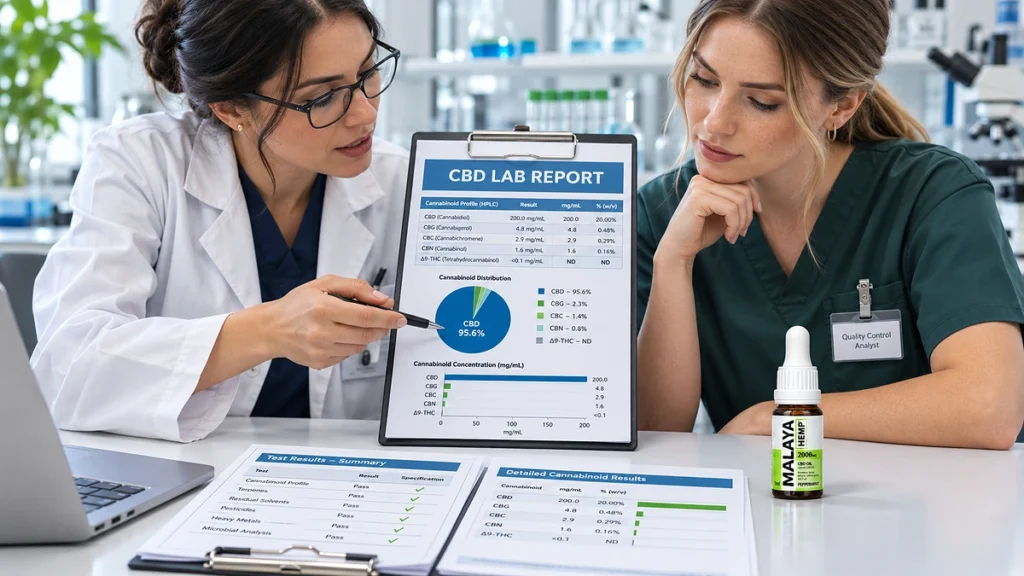
Most laboratories use a process known as High-Performance Liquid Chromatography (HPLC). Although it sounds complicated, it is actually a way of separating all the compounds in a sample and measuring them individually. The test results are then published in a document called a Certificate of Analysis (CoA).
For patients, a CoA is more than an ordinary document. It is evidence that the product you receive has been tested for its THC, CBD and other cannabinoid content, and that it meets strict safety and quality standards. This level of transparency helps your doctor determine the most suitable treatment option and gives you confidence that what you receive is consistent and reliable.
How to Read CBD Lab Reports: What Is the Average THC Content in the UK?
In the UK, the average THC content in prescribed cannabis flower is between 7% and 25%. However, this figure is only part of the whole story. When doctors prescribe cannabis, they do not look only at the percentage of THC in the cannabis. They also examine the full cannabinoid profile and the terpene profile. Both elements play an important role in determining how the medicine works for each patient.
Recreational cannabis, which remains illegal in the UK, is usually produced to maximise its THC content. In this market, strains with a content above 26% are not unusual. However, they do not have the safety measures provided under medical supervision.
Patients prescribed cannabis in the UK benefit from strict regulatory checks, careful laboratory testing and consistent quality standards. This means that the THC figures on recreational products and prescribed products cannot be assumed to produce the same effects.
Context, clinical guidance and product integrity determine all the differences.
For patients, the main point to understand is that prescribed cannabis is chosen carefully and not randomly. Each product is recommended by a specialist registered with the GMC, taking your health history into account.
What Are the Potential Medical Benefits of THC?
The therapeutic value of THC cannot be measured only by one percentage on a label. Although that figure is important, what matters more is how THC interacts with the endocannabinoid system in our bodies. It is also important how it is prescribed in balance with other cannabinoids, and how you respond individually to that prescription.
You may have read this before, but the fact is that there is no one-size-fits-all approach when it comes to THC. Two patients may be given products with the same THC percentage, yet their experiences may be completely different. Factors such as age, medical history and even genetics can influence how THC feels and how effective it is.
- Potential of prescribed THC to relieve symptoms of chronic pain: THC has been shown to be effective in reducing chronic and neuropathic pain. This provides relief to patients for whom standard treatments are ineffective.
- Nausea and vomiting: THC is especially useful for patients undergoing chemotherapy or experiencing gastrointestinal problems.
- Appetite stimulation: THC is beneficial for patients who experience loss of appetite because of illness or treatment.
- Sleep: THC may support better sleep by reducing pain, relieving anxiety and shortening the time taken to fall asleep.
How to Read CBD Lab Reports: Frequently Asked Questions About THC Levels
1. Is 10% THC considered strong?
No. A THC percentage of around 10% is usually considered low strength and is often used as a starting point for new patients.
2. Is 15% THC considered strong?
No. Flower with THC content between 10% and 20% is usually categorised as medium strength.
3. Is 20% THC considered strong?
Yes. In general, 20% is the threshold for high-THC flower. This content is usually prescribed with care, depending on the patient’s history and needs.
4. Is 30% THC too high?
Yes. A level of 30% THC in medical cannabis varieties is very strong and is rarely recommended in the UK. It would only be considered under strict specialist supervision.
5. What THC percentage is safe in the UK?
There is no single figure that is safe for everyone. Safety depends on the condition being treated, the type of product used, and how it is prescribed and monitored.
6. What is considered a high THC content in a vape?
THC vapes usually contain between 85% and 99% THC, but the dose is taken in very small quantities. Their use is only recommended under specialist guidance.
7. What is the highest THC percentage available?
Some products can reach 90% or more, but prescriptions containing more than 30% THC are extremely rare.
How to Read CBD Lab Reports: Understanding High THC Percentages
In a medical context, a high THC content in cannabis usually refers to a product with a percentage between 20% and 30%. This level may provide relief for certain health conditions. However, its benefits and risks depend on the dose, the type of product and the individual factors of the patient. Therefore, supervision by a specialist registered with the GMC is very important.